Short answer
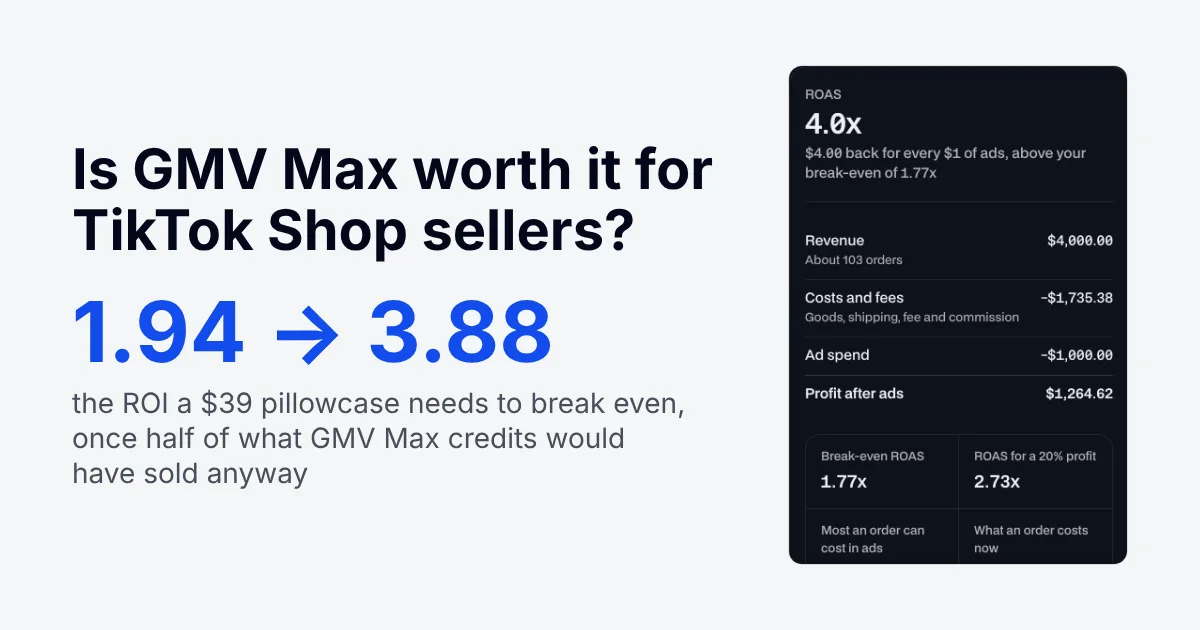
GMV Max is worth it on a product when its dashboard ROI stays above your break-even ROI divided by the share of credited sales the ads actually caused.
TikTok credits every order of a promoted product to the campaign, organic ones too. In our run, ads on the seller's own video broke even at an ROI of 1.87 to 2.95, and ads on affiliate posts at a 15% rate at 2.55 to 4.94. Set Target ROI at that break-even divided by 0.9, so a day ROI protection covers ends at about break-even.
What does GMV Max's ROI actually measure?
Gross revenue of every order for the promoted products while the campaign runs, divided by ad cost. TikTok's Product GMV Max page says "All orders resulting from products you advertise will be attributed to Product GMV Max", organic and affiliate orders included, and its attribution page counts an order even when the buyer never saw an ad. Orders are same-day with a one-day window.
- There's no alternative inside TikTok Shop Ads. Since July 2025, GMV Max is "the default and only supported campaign type for TikTok Shop Ads" (TikTok's migration page).
- Affiliate videos come in automatically. An order from an ad on an affiliate's post pays that creator the standard commission, or a lower Shop Ads rate if TikTok invited you to set one (TikTok's Shop Ads rate page).
- The ROI is revenue, before your costs. As Pattern puts it, "That ratio says nothing about profit" (its guide).
What ROI does a product need to break even?
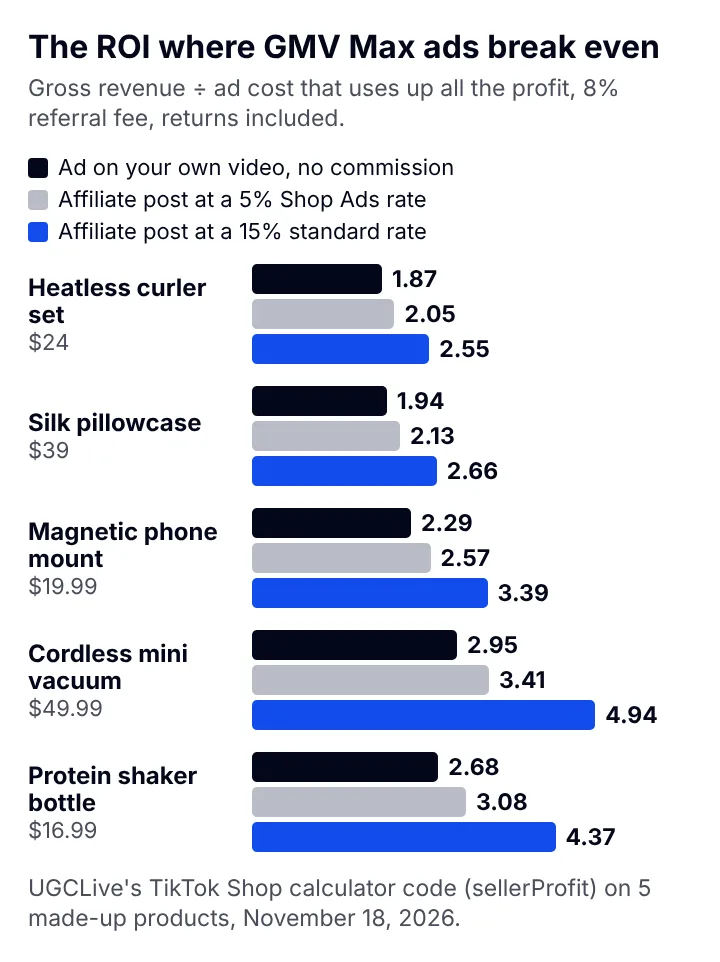
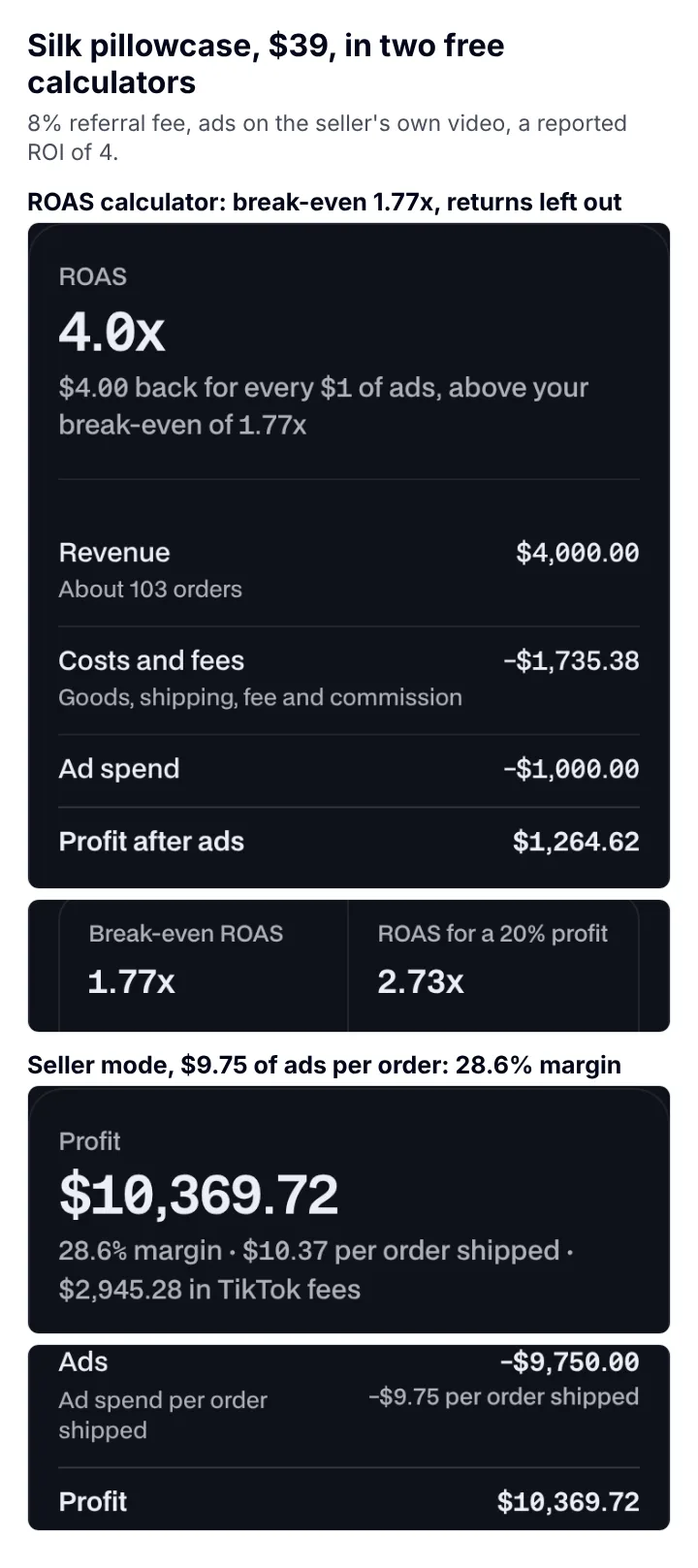
Gross revenue divided by the profit an order leaves before ads. For our $39 silk pillowcase at an 8% referral fee with 7% returned, that's $20.12 per order shipped, so ads break even at an ROI of 1.94 on its own video, 2.13 on an affiliate post at a 5% Shop Ads rate and 2.66 at a 15% standard rate.
| Product | Price, returned | Profit per order before ads (own video) | Own video | Affiliate post, 5% | Affiliate post, 15% | ROAS calculator, own video (no returns) |
|---|---|---|---|---|---|---|
| Heatless curler set | $24, 5% | $12.85 | 1.87 | 2.05 | 2.55 | 1.74 |
| Silk pillowcase | $39, 7% | $20.12 | 1.94 | 2.13 | 2.66 | 1.77 |
| Magnetic phone mount | $19.99, 6% | $8.71 | 2.29 | 2.57 | 3.39 | 2.08 |
| Cordless mini vacuum | $49.99, 9% | $16.94 | 2.95 | 3.41 | 4.94 | 2.56 |
| Protein shaker bottle | $16.99, 4% | $6.33 | 2.68 | 3.08 | 4.37 | 2.49 |
Whose video the ad runs on moves it most: a 15% commission lifts the vacuum's break-even from 2.95 to 4.94, because ads that use affiliate posts still pay commission. Returns come next: our ROAS calculator, which leaves returns out, puts the pillowcase at 1.77, while the seller calculator with its 7% returned gives 1.94. The fee matters less: at 6% instead of 8%, the pillowcase's own-video break-even drops only to 1.87.
- Open seller mode
In the TikTok Shop commission calculator, pick Seller fees and profit, and type your price, goods, shipping, packaging, return rate and referral fee.
- Set commission for the ads you expect
0% if most ads will run on your own videos; your standard rate if they'll mostly use affiliate posts. Leave Ad spend per order at 0.
- Divide your price by profit per order shipped
$39 ÷ $20.12 = 1.94 for the pillowcase. That's the ROI where ads take all the profit.
How much of the dashboard ROI would have sold anyway?
Whatever share of credited sales would have come without ads, and the break-even ROI on the dashboard rises with it: divide the break-even by (1 − that share). If half of what GMV Max credits to the pillowcase would have sold organically, the dashboard has to show 3.88 before the ads pay for themselves, double its 1.94.
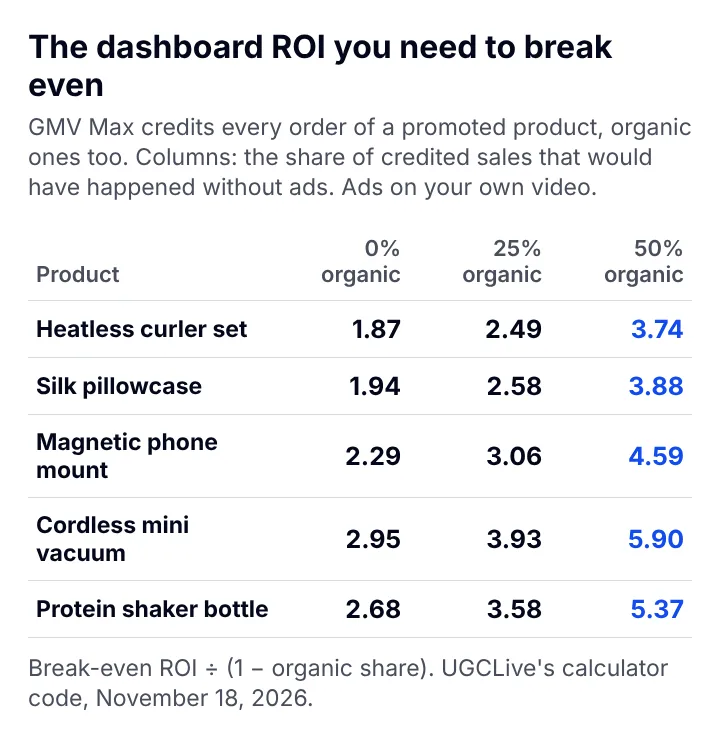
Delzonic calls this "A reported 7.0 that is really a 2.0" (its post). To get your own share:
- Not running GMV Max on the product yet: note its daily GMV over the last 14 days with no ads, then after a week of the campaign divide that baseline by the campaign's average daily GMV.
- Already running it: Delzonic's test, "Turn GMV Max off on one product for two weeks and watch what happens to its revenue." Its daily GMV while paused, divided by its daily GMV while running, is the share. Pause a product that sells steadily, since a paused campaign earns no protection either.
- Look up the dashboard ROI you need in a table like the one above, or work it out: break-even ÷ (1 − share).
The share drifts with viral videos and fading products, so redo it monthly. A baseline taken during the November 11 to 30 sales campaign will make the ads look worse than they are.
What target ROI should you set?
Your dashboard break-even divided by 0.9, on Target ROI. ROI protection credits back the spend above that line on any day the campaign's ROI ends below 90% of the target and it had more than 20 orders (TikTok's ROI protection page), so a target at break-even ÷ 0.9 caps a protected day at break-even.
We ran TikTok's formula, "Ad credit = total cost − total gross revenue / (daily ROI target × 0.9)", on its own example first and got its $15.56. Then on a bad day for the pillowcase: $1,000 spent and an ROI that ends at 60% of the target.
| Target ROI | ROI reached | Orders | Profit without protection | Credit | Profit with credit |
|---|---|---|---|---|---|
| 1.94 (break-even) | 1.16 | 30 | −$399.38 | $333.33 | −$66.04 |
| 2.16 (break-even ÷ 0.9) | 1.30 | 33 | −$331.26 | $333.33 | $2.07 |
At a target of 1.94 the credit leaves a $66.04 loss, because protection only refunds down to 90% of the target, here 1.75. At 2.16, 90% of the target is the break-even itself, and the day ends at $2.07.
Protection needs more than 20 orders a day, and at break-even ÷ 0.9 that takes $114.11 to $361.86 of daily spend across our five products (20 × price ÷ target): the $16.99 shaker the least, the $39 pillowcase the most. The day is also lost if you raise the target, lower it twice, pause or delete the campaign, or edit its products.
Two limits on the word "covered". The credit is ad credit added to your account, so it pays for later ads, never your goods. And it's worked out from that day's gross revenue, so returns that arrive weeks later aren't in it. The break-evens above assume your usual return rate; if holiday returns run higher, the pillowcase's break-even goes from 1.94 at 7% returned to 2.18 at 15% and 2.59 at 25%, so the protected target goes from 2.16 to 2.42 and 2.88. Trellis notes that items sold November 11 to December 31 can be returned until February 10, 2027, and that campaign ads the system creates for the sale "do not stop on their own when the promotion ends", so check your campaigns on December 1. Our Black Friday post has the campaign dates from the affiliate side.
Each step of target above break-even is margin you keep. In seller mode with ads per order at price ÷ target, the pillowcase keeps 19.6% at a target of 3, 28.6% at 4 and 37.6% at 6. TikTok's recommended ROI comes from "similar liverooms or products" (its page), never your costs, so read it as what the market reaches, and if it sits below your target, the product isn't ready for ads.
Which products is GMV Max not worth running on?
Low-margin products advertised through affiliate posts, mostly. The vacuum at a 15% rate needs 4.94 with no organic sales and 9.88 if half the credited sales are organic; the shaker 4.37 and 8.75.
- Skip it when the protected target (break-even ÷ (1 − organic share) ÷ 0.9) is above TikTok's recommended ROI for the product, or when 20 orders a day would cost more than you'll spend.
- Feed it your own videos when affiliate posts push the break-even up: the curler goes from 2.55 to 1.87. If TikTok invites you to set a Shop Ads rate, the minimum is 30% of your standard rate (setup page); at 5% the curler breaks even at 2.05.
- Run it on products with a known organic share and a protected target the market reaches.
- With GMV Max Pro on your account, commissions feed its optimization, Trellis says (its post), and Pattern's advice is to "check how it treats affiliate commission before you subtract it yourself". If the ROI it reports already nets commission out, set the target from the own-video column, or you count commission twice.
If what's missing is your own videos for GMV Max to run, our AI makes TikTok Shop videos from a product link at ugc.live/shop. Our commission post covers the rate side, and selling on TikTok Shop the rest of the setup.
What's left out of these numbers?
All of it is arithmetic on made-up products and TikTok's published formulas; with no seller account, no real campaign or credit statement went into it. Also:
- Incrementality. The organic share is the one input you have to measure; a 14-day baseline is rough, and holiday weeks skew it.
- GMV Max Pro and coupons. Trellis says TikTok describes Pro as rolling out to some advertisers. We had no account with it, so we couldn't see how its ROI treats commission or coupons.
- Free samples, LIVE GMV Max and sales on other channels. Samples raise the break-even; our commission post prices them.
- Which fee you pay. We ran 8%, which Delzonic reports since August 4, 2026 (fee post), and 6% for comparison.