Short answer
A media kit is a one or two page summary a creator sends a brand: who you are, your platforms and reach, who your audience is, recent work, what you offer and what it costs.
The six examples below are one page each and follow the same order, because that order matches what TikTok One and Instagram's creator marketplace show brands: followers and views, engagement rate, audience age, gender and location, then recent posts. What changes by niche is which platform leads and which services you sell.
How do the six media kit examples compare?
All six are one page, use our template's Media kit layout and differ only in accent colour, so what changes between them is the content: which platform leads, who the audience is and what's for sale. Here they are side by side; each one follows, numbered, with what it gets right.
- 1. Mara OkaforSkincare, sensitive skin
- Leads withTikTok, 18.4K
- Total following24.6K
- Average views11.2K
- Engagement6.1%
- Audience18–34, 82% women
- 2. Sam WhitlockDesk setups, gadgets
- Leads withYouTube, 27.5K
- Total following40.4K
- Average views21.4K
- Engagement4.0%
- Audience18–34, 78% men
- 3. Dev RamanHome workouts, strength
- Leads withYouTube, 41K
- Total following64.5K
- Average views14.8K
- Engagement3.4%
- Audience25–44, 64% men
- 4. Lucía FerrerWeeknight dinners, one pan
- Leads withTikTok, 9,600
- Total following28.9K
- Average views7,300
- Engagement7.4%
- Audience25–44, 71% women
- 5. Nell BradyDogs, puppy training
- Leads withInstagram, 32K
- Total following40.7K
- Average views9,900
- Engagement5.6%
- Audience25–44, 76% women
- 6. Ada LindCarry-on travel, packing
- Leads withTikTok, 26.3K
- Total following38.1K
- Average views16.7K
- Engagement4.8%
- Audience25–34, 68% women
Fictional creators made for this page; every figure is made up and appears on the kit images below. The template also offers a second page, which the six didn't need.
1. Skincare media kit example: what a brand reads first
Mara Okafor's kit is marked up with what a brand reads first, which is what its own tools show it. TikTok One, where brands find TikTok creators, opens a creator profile on performance (follower growth, video views and engagement rate over time), audience (age, gender, country) and recent organic and sponsored videos. Instagram's creator marketplace data for brands has the same shape: followers, accounts reached and engaged, broken down by age, gender, top countries and cities, plus recent and branded posts. So a kit that leads with those numbers answers the brand's first questions in the order it asks them.
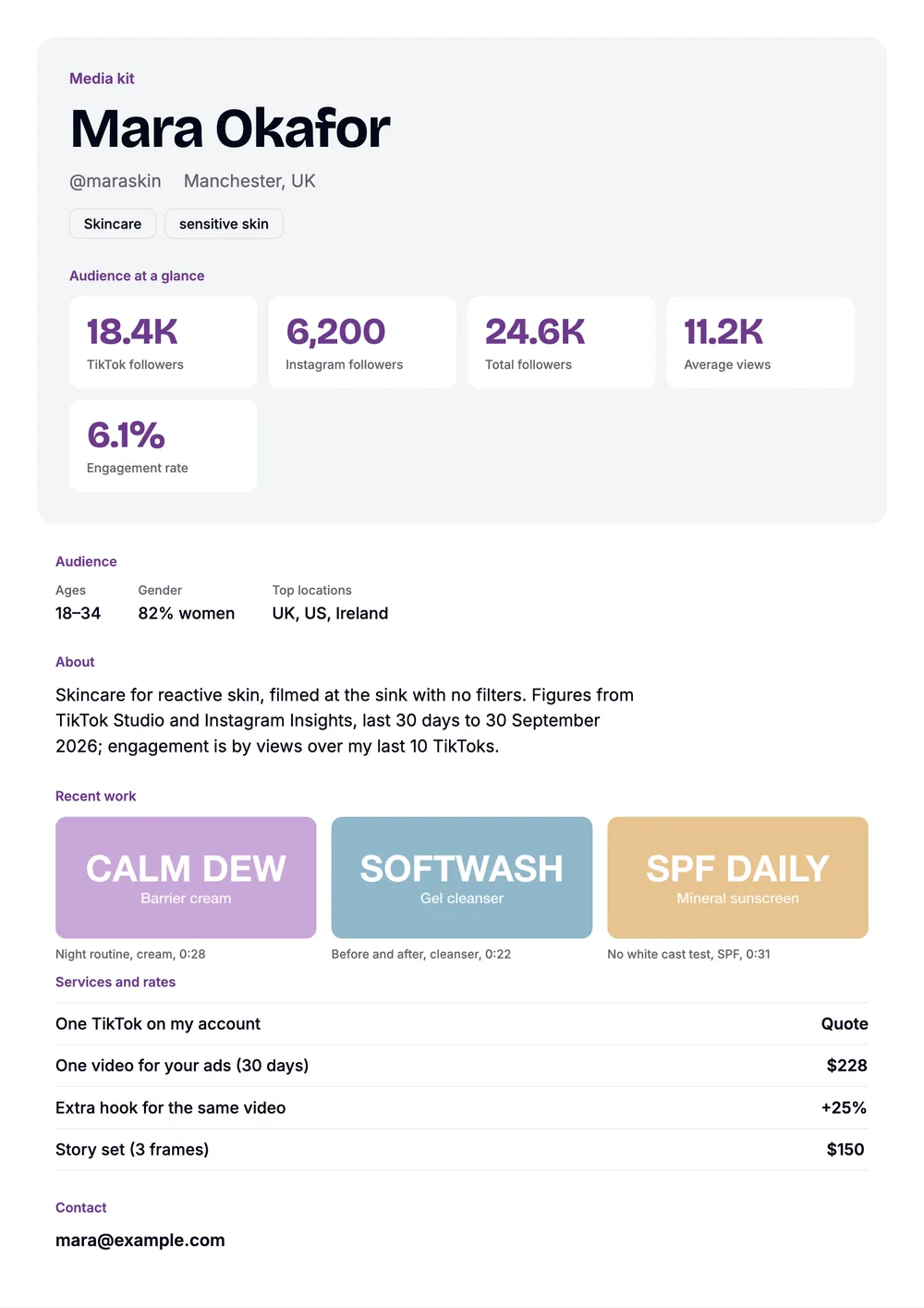
- Followers and average viewsTikTok One lets brands filter and sort by follower count and median video views.
- Engagement rate, with its methodA TikTok One filter. Instagram reports a Reels interaction rate over 90 days, so say which rate yours is.
- Audience age, gender and locationTikTok One's audience filters: location, age range and gender ratio.
- Where the numbers came from, and whenBoth platforms show figures for a time window; the kit says which apps and which month.
- Recent workTikTok One shows recent organic and sponsored videos; Instagram returns recent and branded posts.
- RatesNeither platform's creator data that we read has a price field. This is the part only your kit carries.
The bio line does a job the numbers can't: it names the apps (TikTok Studio, Instagram Insights), the window (the 30 days to 30 September 2026) and the engagement method (by views, last 10 TikToks). A brand can then check the kit against the screenshots attached, or against what TikTok One shows it.
2. Tech media kit example: YouTube first
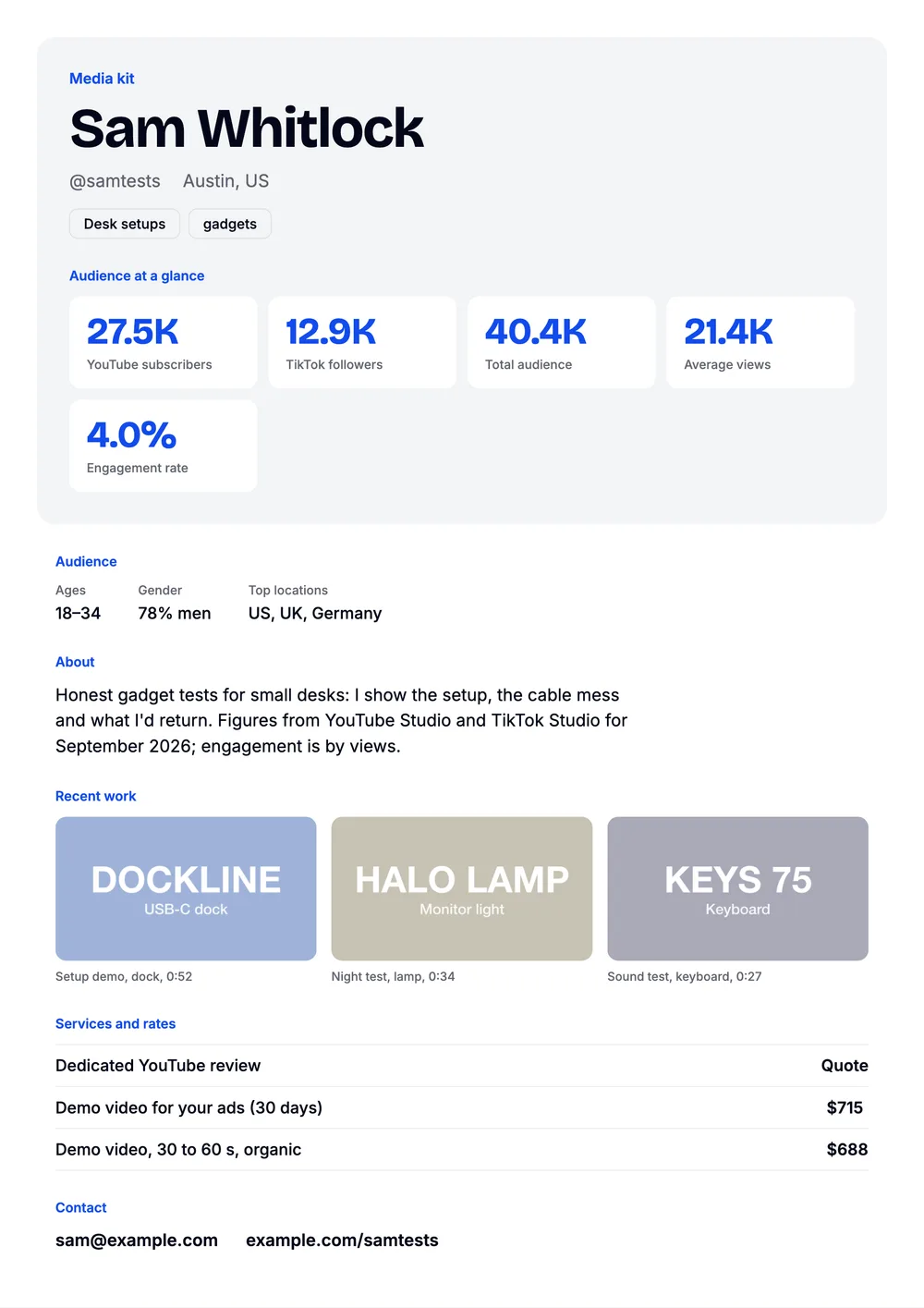
Sam Whitlock (desk gadgets) has the biggest following and the longest videos on YouTube, so it leads the kit, with TikTok beside it. The template labels a YouTube row "subscribers", which is the word YouTube Studio uses. The dedicated review is a Quote: a posting fee depends on your reach, which our rate calculator doesn't price, so the kit prices the demo videos and quotes the placement.
3. Fitness media kit example: a 90-day ad line
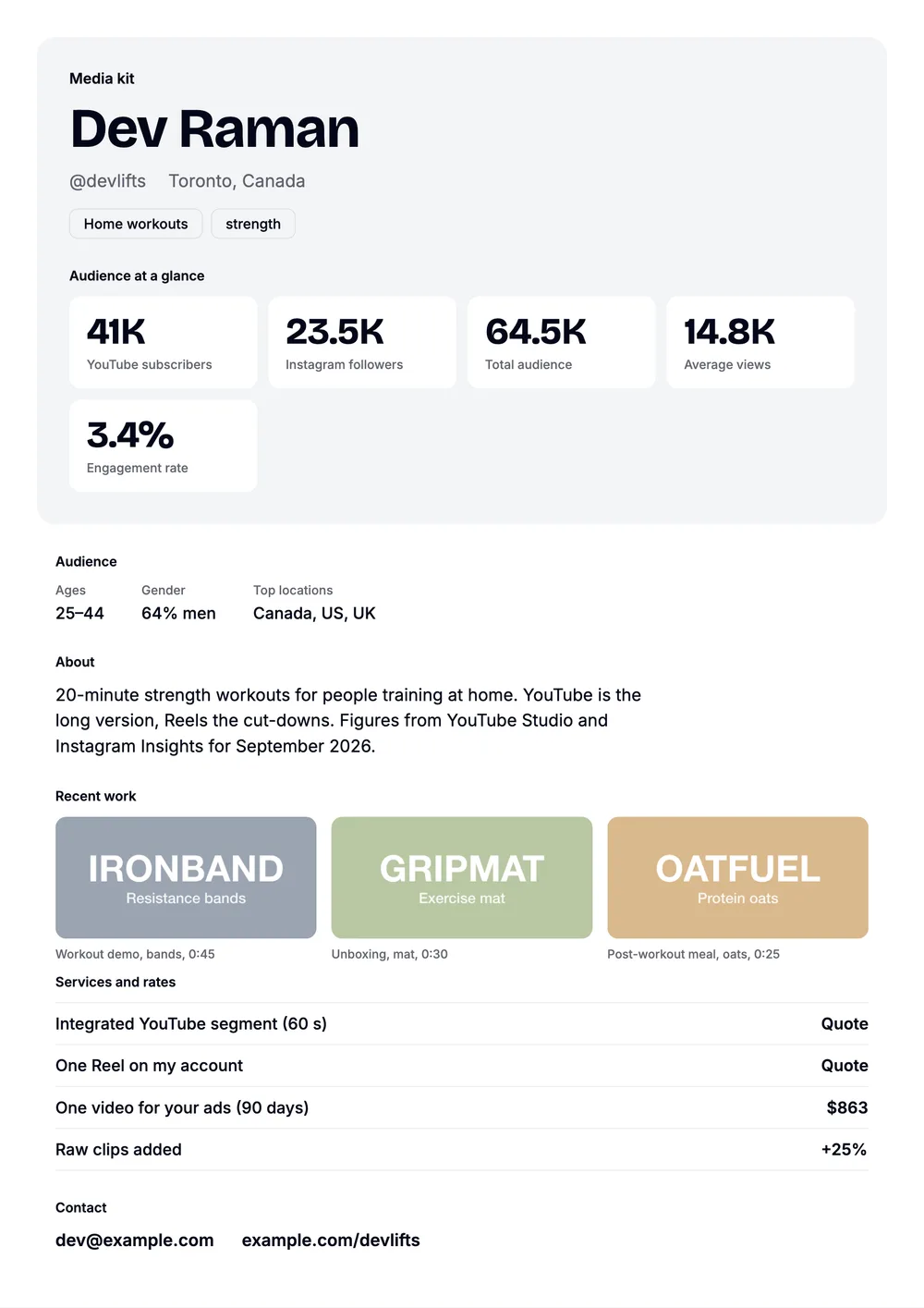
Dev Raman (home workouts) also leads with YouTube, with Instagram second, and quotes both the YouTube segment and the Reel. The one priced video covers 90 days of ads instead of 30, so a brand that wants to keep a working ad running longer sees that price up front: the calculator adds 50% for 90 days of ads, against 30% for 30 days.
4. Food media kit example: when saves matter more than views
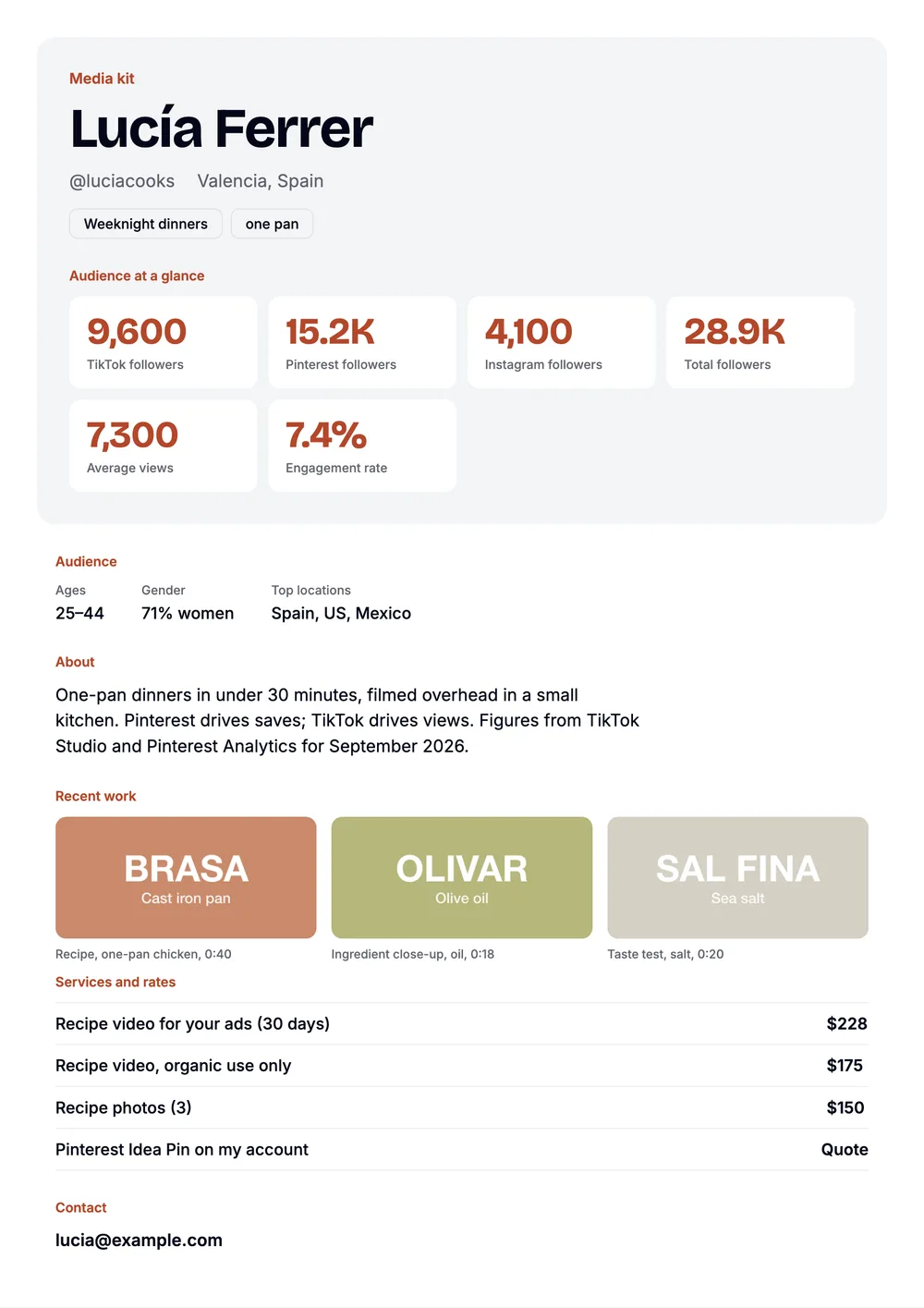
Lucía Ferrer's kit, in three numbers (made up)
- 15.2K
- Pinterest followers, her biggest following
- 7.4%
- engagement rate, the highest of the six
- $150
- for 3 recipe photos, from the rate calculator
Fictional creator; the photo price is the UGC rate calculator's typical figure for 3 photos at the beginner tier.
Recipe content gets saved and cooked later, so Lucía Ferrer's bio says Pinterest drives saves and TikTok drives views, and her services include photos as well as video. A brand buying recipe content may want stills as well as a video, so the photo line sits next to the video ones.
5. Pet media kit example: where the audience lives
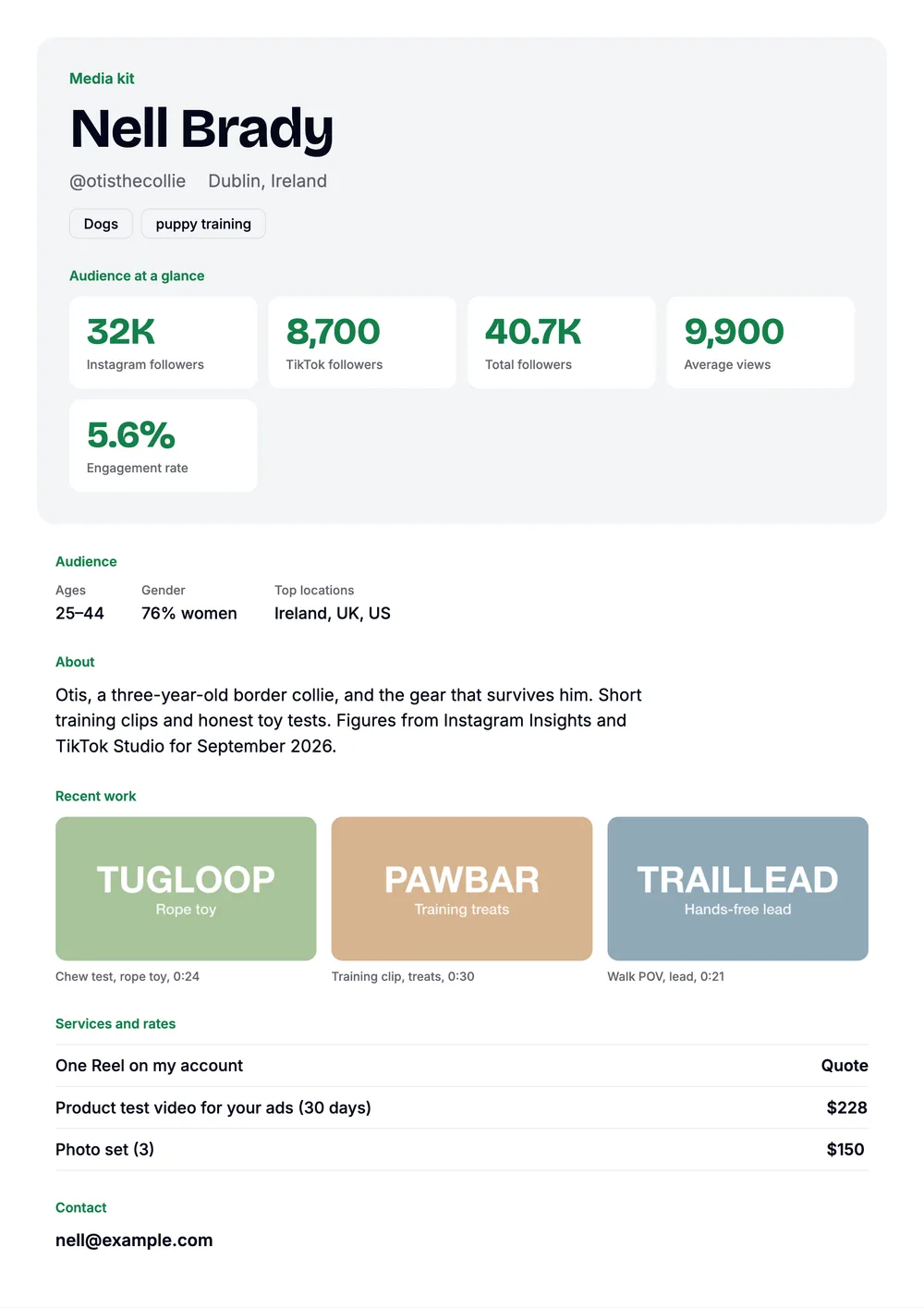
Pet products are often sold in some countries only, and the Top locations row is where a brand checks that: Nell Brady's audience is in Ireland, UK, US, so a brand that ships only to the US can rule the account in or out from that row. The bio says what it is about in one line ("Otis, a three-year-old border collie"), so the niche is clear before the numbers.
6. Travel media kit example: one line for the niche
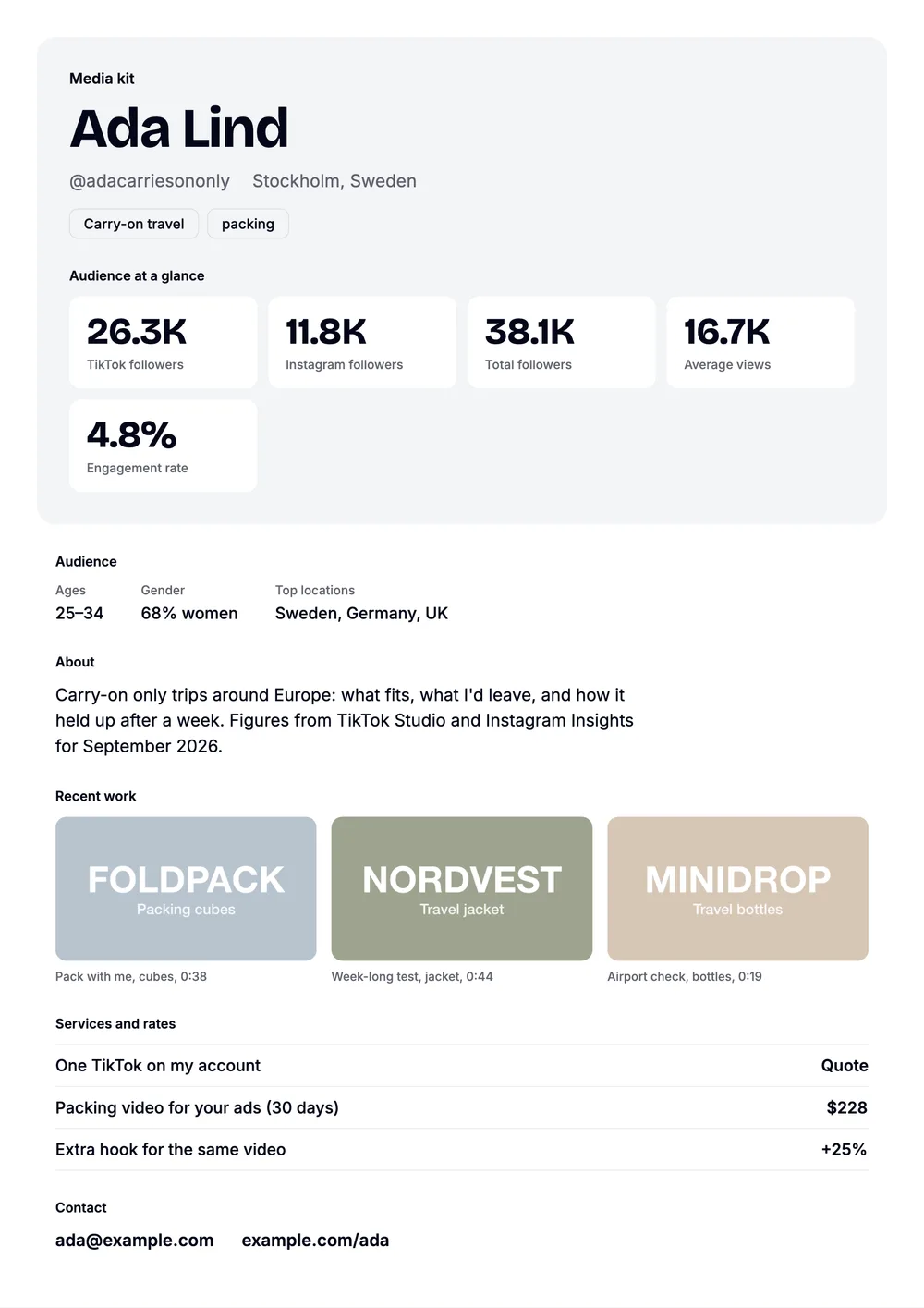
Ada Lind's bio opens on one line ("carry-on only trips around Europe"), and the audience row (Sweden, Germany, UK) does the same job as the pet kit's: it tells a luggage or travel brand at a glance whether those viewers can buy what it sells. The extra hook is priced at 25% of the video, so a brand can order test versions without a new quote.
What must every media kit include?
On all six
- Yes: Followers per platform, with the one you're pitching at the top
- Yes: Average views, beside followers
- Yes: Engagement rate, and the method behind it in the bio
- Yes: Audience age, gender and top locations
- Yes: The apps and month the figures come from
- Yes: Three recent pieces of work, captioned with format, product and length
- Yes: Services and prices, with posting on your account as a quote
- Yes: An email address
Left off
- No: Brands you can't name: none of the six has paid clients yet, so none lists any
- No: Follower counts for platforms you don't post on
- No: Rounded-up numbers you couldn't show a screenshot for
Our checklist for the six kits, built around the fields TikTok One and Instagram's creator marketplace show brands (read 16 October 2026).
If brands ask you for videos to run as their own ads more than for posts on your account, a portfolio fits better than a kit: see the sample UGC portfolios, made with the same builder.
How are the rates on these kits priced?
One video a brand runs as an ad, as priced on each kit
| Mara Okafor, skincare | $228 |
|---|---|
| Lucía Ferrer, food | $228 |
| Nell Brady, pets | $228 |
| Ada Lind, travel | $228 |
| Sam Whitlock, tech | $715 |
| Dev Raman, fitness | $863 |
Typical figures from our UGC rate calculator for one edited 15 to 30 second video, no extra hooks, at the tier, niche and ad window shown.
Each video line on the kits is our UGC pricing calculator's typical figure for the creator's tier and niche. The four beginners land on the same $228: the calculator adds nothing for beauty, food, pets or general consumer products, and adds 30% for 30 days of ads. The gap comes from experience (the intermediate tier's base is higher) and from the calculator's niche steps: 10% for tech and 15% for health and fitness. Dev Raman's line also covers 90 days of ads, priced 50% over the base. Posting on the creator's own account is a Quote on every kit, since the calculator has no input for reach. For how to price that part, see our brand deals guide.
What didn't we check?
Not checked
- Partly: Whether these kits win deals: the creators are fictional, so nothing here was sent to a brand.
- Partly: What brands see inside TikTok One and Instagram's marketplace: we read TikTok's help page and Meta's API documentation, and didn't sign in as a brand.
- Partly: How Instagram's marketplace calculates its Reels interaction rate: Meta's documentation names the metric and window without a formula.
- Partly: Real audience data: every follower count, view count and audience figure on the six kits is made up.