Short answer
A UGC portfolio leads with sample videos, because brands hire you to make videos they post themselves, so your own followers matter less.
The five examples below put the samples near the top, caption each with its format, product and length, and price the video and its usage separately. Insense asks UGC-only applicants for 6 to 12 videos across at least 2 product categories and 2 formats, with on-camera and voiceover examples; of our five, only the six-sample portfolio meets every countable part of that.
How do the five UGC portfolio examples compare?
Five creators in five situations, from a first-timer with only spec ads to a creator with two years of paid work, all made with the same free builder. Here they are side by side; each one follows, numbered, with what it gets right.
- 1. Rosa DelgadoNo clients or followers yet
- Samples3 spec ads
- LayoutClean
- First screenBio saying every video is a spec ad, then three tall samples
- Video from$175
- 2. Kofi MensahFaceless, hands and voiceover
- Samples4, no face on camera
- LayoutSoft
- First screenBio that says faceless, beside a 2 by 2 grid of samples
- Video from$193
- 3. Hana SatoMeets Insense's countsRange across two categories
- Samples6, food and wellness
- LayoutBold
- First screenBio naming the range, then six samples in two rows
- Video from$175
- 4. Leo BrandtOne niche: a cat
- Samples4 pet products
- LayoutClean
- First screenBio about the cat, one platform, four samples
- Video from$175
- 5. Maya EllisonTwo years of paid work
- Samples4 across beauty and fashion
- LayoutBold
- First screenBio about paid work and hooks, then a row of four samples
- Video from$500
Fictional creators made for this page. Prices are our UGC rate calculator's typical figure for each creator's first service line.
1. A UGC portfolio with no clients yet
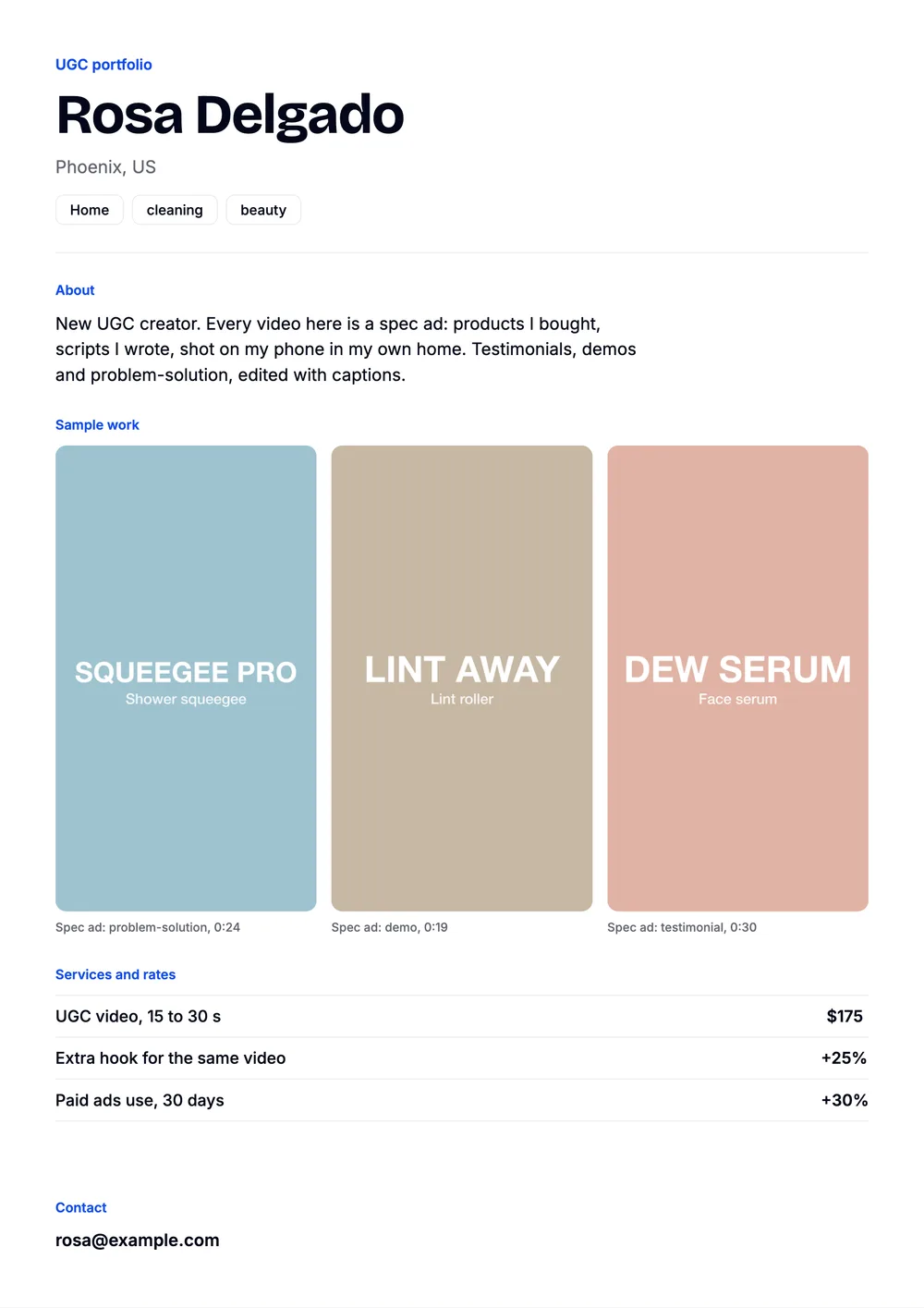
Rosa Delgado's is made of spec ads, labelled as spec ads. She bought the products, wrote the scripts and filmed at home, and her bio and every caption say so ("Spec ad: demo, 0:19"). With no platforms filled in, the template leaves the followers row out instead of showing an empty one. Her price, $175 a video, is the rate calculator's typical beginner figure, with hooks and paid usage as add-ons. Three samples is a start; it's under what Insense asks for, so she'd add more before applying there.
2. A faceless UGC portfolio
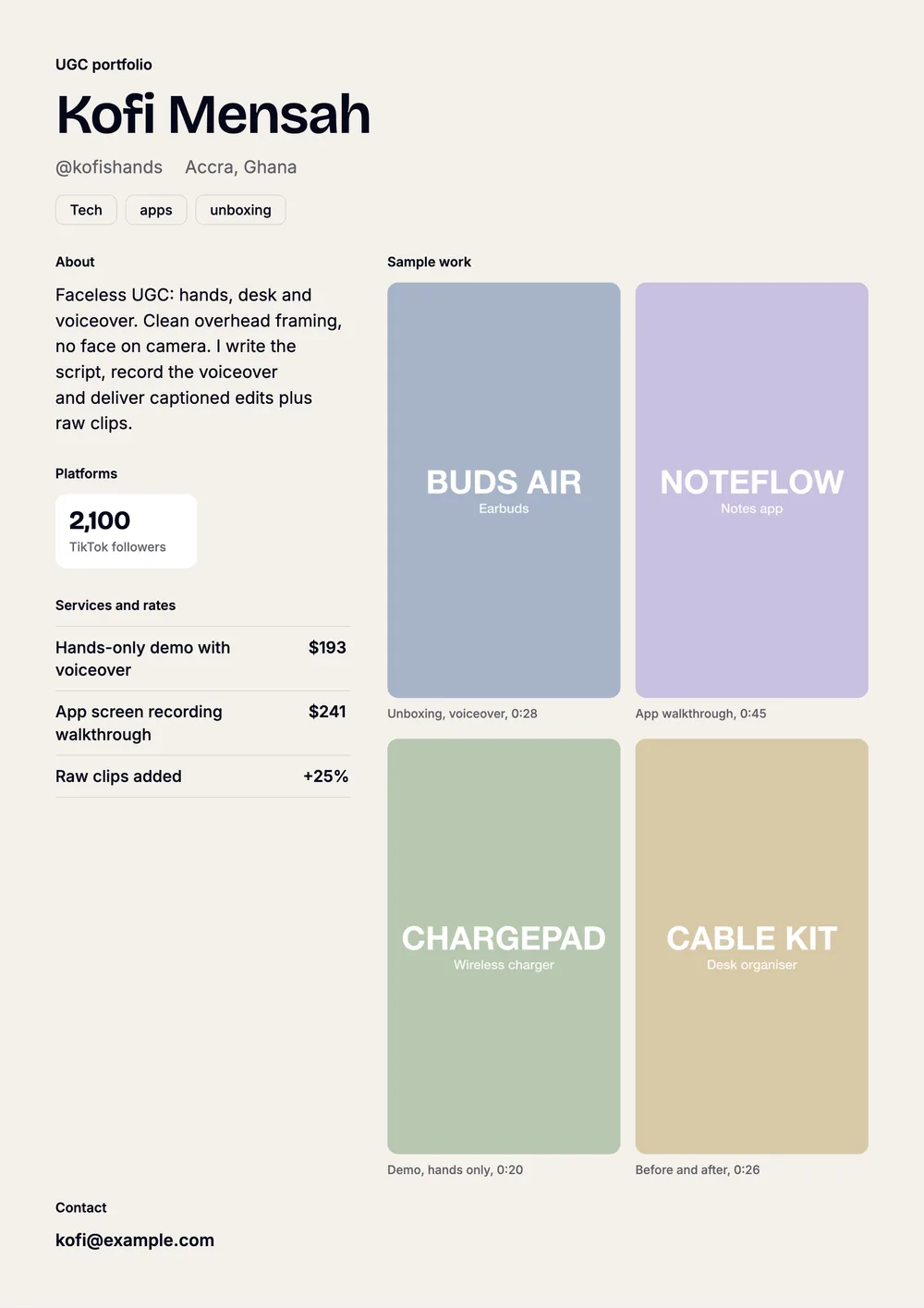
For gadgets and apps the product on screen carries the video, and Kofi Mensah's bio says what he delivers: script, voiceover, captioned edit and raw clips. His app walkthrough runs 30 to 60 seconds, so the rate calculator prices it at $241, above his $193 demo.
3. A UGC portfolio with range: six samples
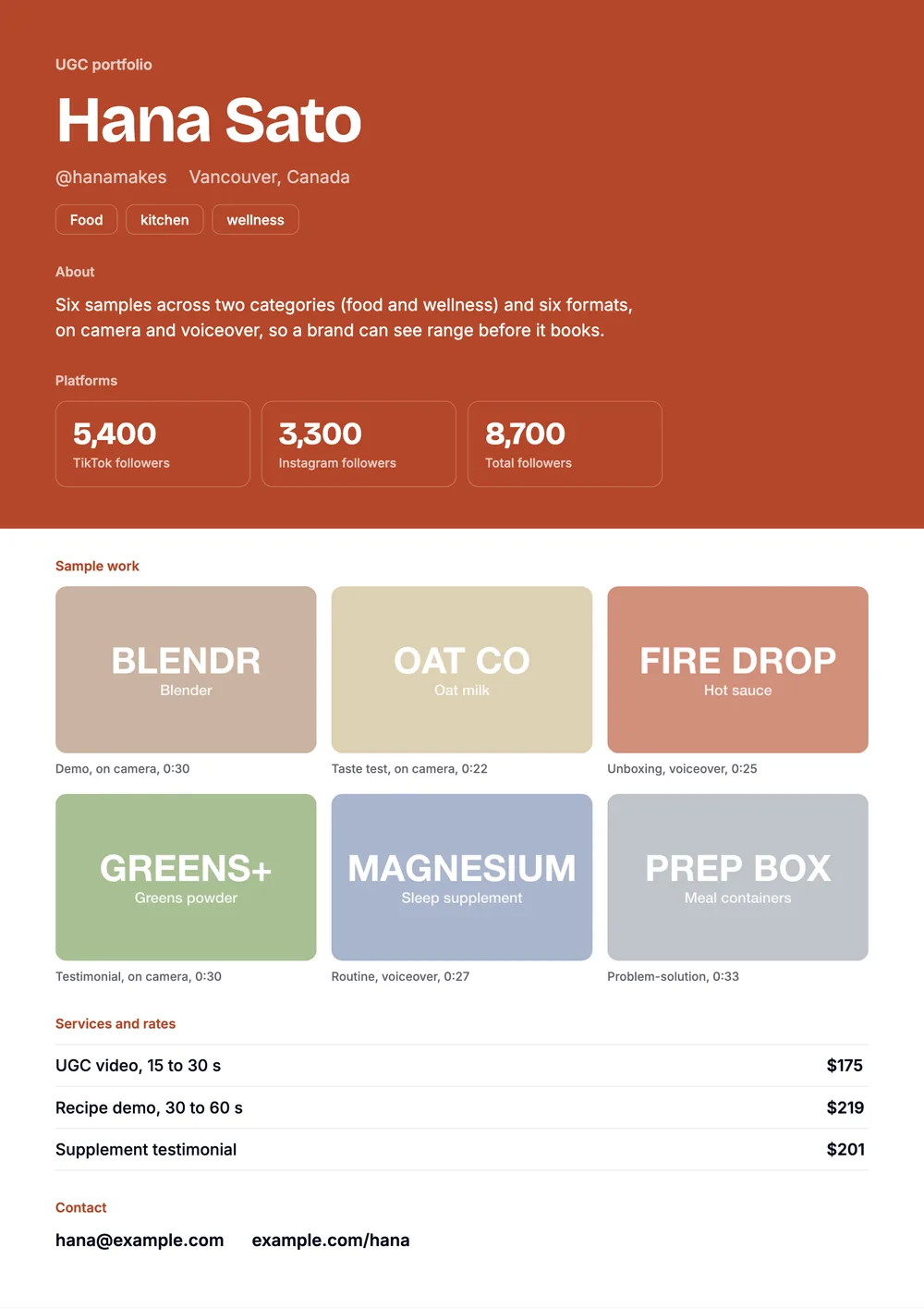
Hana Sato's six cover two categories and six formats, and her captions say which are on camera and which are voiceover, the parts Insense names. It's the only one of the five that meets every countable part of Insense's rules for UGC-only applicants, and the Bold layout sets six samples in two rows without making the page long.
4. A one-niche UGC portfolio
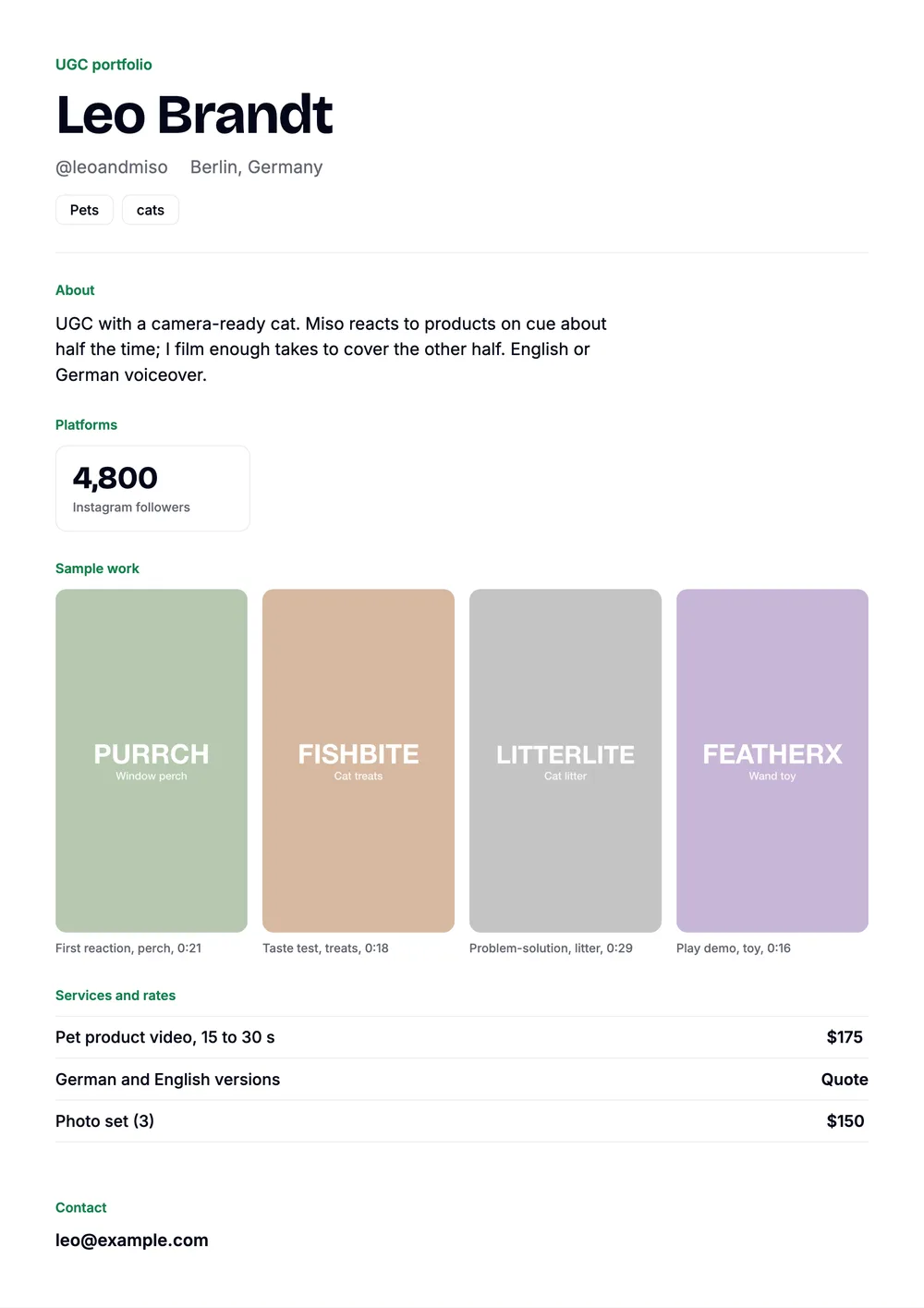
It shows what only he can film. Leo Brandt's cat is the reason a pet brand would pick him, and Billo's creator profiles tell brands what a creator can show in a video, with pets as one of its examples. His bio is also honest about the work ("Miso reacts to products on cue about half the time"), and he sells a second language as its own line. One niche is fine for pitching pet brands directly; for Insense's second category he'd add, say, home products filmed in the same flat.
5. A booked creator's UGC portfolio, annotated
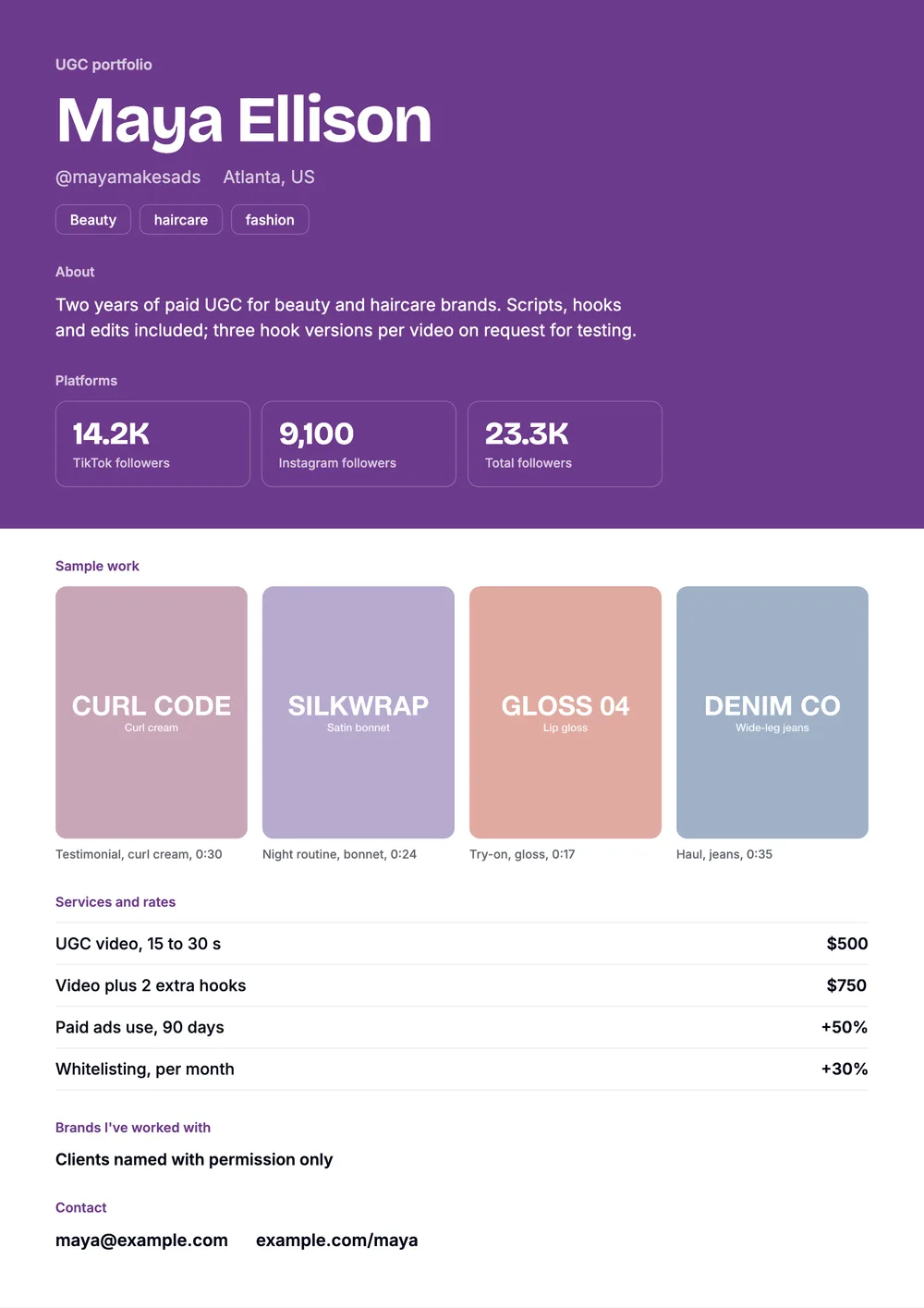
- Followers, small and optionalBillo's brand view shows videos created, rating and on-time share, with no follower count.
- Samples high on the pageBillo shows brands your pitch and 3 most recent approved videos, so put your best 3 first.
- Format, product and lengthInsense asks for at least 2 formats; the caption is where a brand sees which.
- Hooks as their own lineExtra openings for ad testing, priced with the rate calculator.
- Usage priced separatelyPaid ads and whitelisting as percentages on top of the video.
- Clients named only with permissionLeave the line out until a brand agrees to be named.
Maya Ellison has two years of paid work, and the portfolio shows it without leaning on followers: four samples across beauty and fashion in one row, extra hooks and ad usage priced as their own lines, and a brands line kept only for clients who agreed to be named.
What do brands look at first in a UGC portfolio?
The videos. When a brand on Billo reviews a creator who applied to its brief, it sees the creator's video pitch (30 seconds at most) and their 3 most recent approved videos, next to three numbers. Follower counts aren't among them. A portfolio you send yourself does the same job, so the samples go high on the page.
- A video pitchUp to 30 seconds introducing you.
- 3 recent videosThe most recent approved videos made for other brands.
- Videos created and ratingHow many approved videos, and their average rating.
- On-time shareThe share of videos delivered within 5 days.
How many samples should a UGC portfolio have?
- 6–12
- videos Insense asks UGC-only applicants for
- 2+
- product categories, and as many formats
- 3
- extra video examples Billo shows beside your pitch
Insense's help page for UGC-only creators and Billo's help pages for creators and brands, read 16 October 2026; Insense's rechecked 27 October 2026.
Enough to show range. If Insense turns an application down, its page says you can reapply through the app after 14 days, so filling the gaps first saves the wait. On Billo the count matters less: brands see your pitch, the 3 examples you add and, as you work, your most recent approved videos. For a one-page portfolio you send yourself, three to six is a good range.
Do the five meet Insense's portfolio rules?
Hana Sato
- Yes: 6 videos
- Yes: 2 categories: food and wellness
- Yes: 6 formats
- Yes: On camera and voiceover, both captioned
Maya Ellison
- No: 4 videos, under 6
- Yes: 3 categories: beauty, haircare, fashion
- Yes: 4 formats
- Partly: On camera or voiceover not stated
Rosa Delgado
- No: 3 videos, under 6
- Yes: 2 categories: home and beauty
- Yes: 3 formats
- Partly: On camera or voiceover not stated
Kofi Mensah
- No: 4 videos, under 6
- Yes: 2 categories: tech and apps
- Yes: 4 formats
- No: Voiceover only, no on-camera speaking
Leo Brandt
- No: 4 videos, under 6
- No: 1 category: pets
- Yes: 4 formats
- Partly: Voiceover in his bio; on camera not stated
Insense's rules for UGC-only creators (6–12 videos, 2+ categories, 2+ formats, on-camera and voiceover examples, read 16 October 2026 and again 27 October 2026), checked against each sample portfolio's captions and bio. Lighting, audio and editing quality, also on Insense's list, can't be judged from product cards.
What didn't we check?
Not checked
- Partly: Whether these portfolios get hired: the creators are fictional and nothing was sent to a brand or platform.
- Partly: Video quality: the samples are flat product cards, so Insense's lighting, audio and editing rules can't be judged.
- Partly: What brands see on Insense: its page lists what applicants need, not what brands see.
If brands want you to post on your own account as well, add your audience numbers and make a media kit instead: see the sample media kits, made with the same builder.