Short answer
A 10-second script holds about 25 spoken words at 150 words a minute (21 if you talk slowly, 28 if you talk fast).
Write three lines: a hook of 7 words finished by 3 seconds, one proof line of 12, and a call to action of 5. Count words the way you say them, since "$20" is two words and "USB-C" is four, and write the 10-second version as its own script: trimming longer takes to their first 10 seconds lost the closing line, where the call to action sits, in all 6 of our tests.
How many words is a 10-second script?
About 25 at 150 words a minute. Teleprompter.com puts conversational speech at 125 to 150 words a minute and social clips at "170+", and Lemonlight plans on two words a second, which is 20 words for 10 seconds. Your own pace decides which is right.
| Your pace | Words in 10 seconds | Who talks like this |
|---|---|---|
| 130 wpm | 21 | Slow and clear, product names and prices |
| 150 wpm | 25 | Relaxed, the free teleprompter's default |
| 170 wpm | 28 | Quick and punchy, Teleprompter.com's pace for social clips |
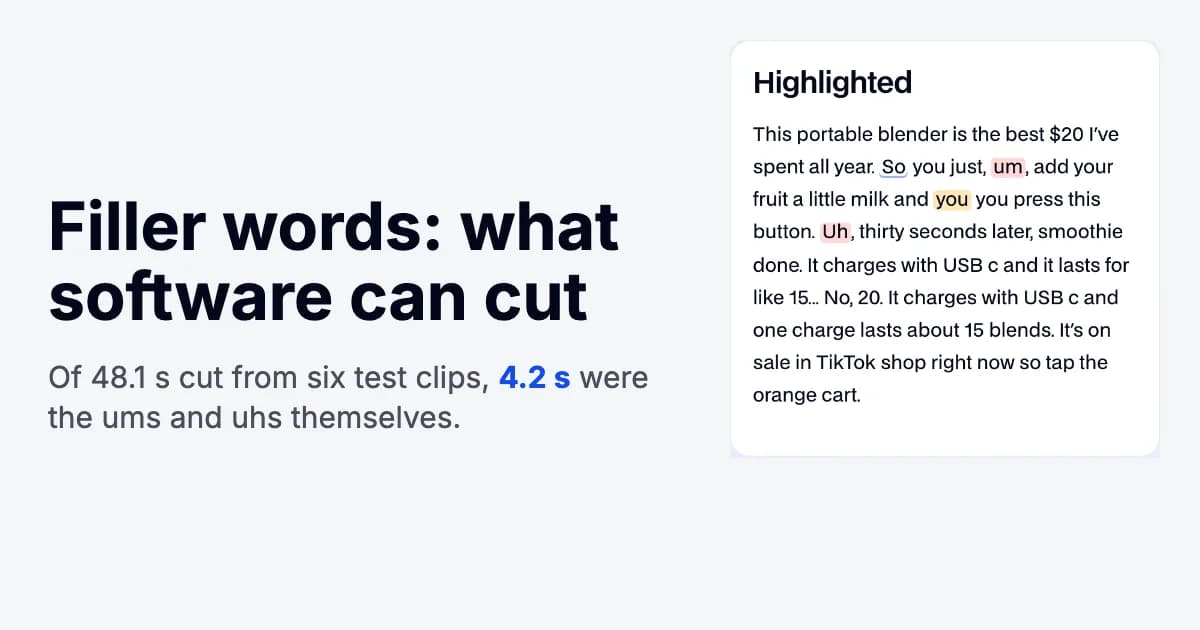
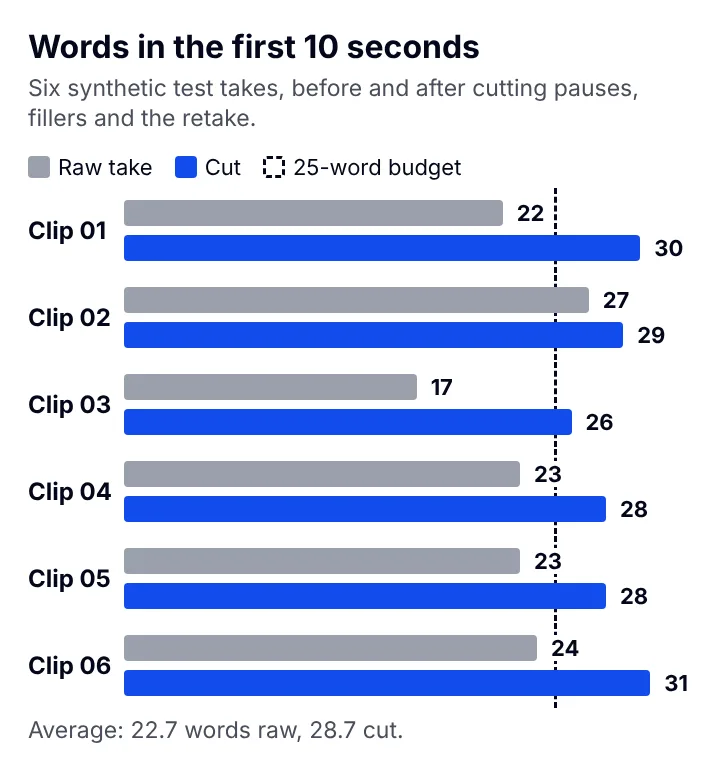
If you leave a beat after the hook or a pause for the product shot, budget less: Teleprompter.com's allowance of 10 to 15% for pauses takes 25 words down to about 21. To find your pace, read a 100-word paragraph into our free teleprompter or a timer: 40 seconds is 150 words a minute. We also counted the words in the first 10 seconds of six synthetic test takes (AI voices with planted pauses, ums and a retake): 17 to 27 words raw, and 26 to 31 once the pauses, fillers and retake were cut. The voices are faster than most people, so take the direction, not the numbers: pauses eat a raw take's budget, and a tight cut gives some back.
What goes in a 10-second script?
Three lines and a first frame: a hook, one proof, one call to action. TikTok's ad guidance says to "introduce your content proposition in the first 3 seconds", which in a 10-second video is almost a third of it, so the picture and the on-screen text have to start the hook before you finish saying it.
| Line | Seconds | Spoken words | Its job |
|---|---|---|---|
| Hook | 0 to 3 | 7 | The result or the problem, with a first frame and on-screen text that show it |
| Proof | 3 to 8 | 12 | One fact the camera shows while you say it |
| Call to action | 8 to 10 | 5 | One thing to do: the cart, the bio, a comment word |
There's no room for a greeting, your name or a second benefit. Put anything that can be read instead of said, like a price or a size, on screen.
What do 10-second scripts look like?
Here are five, one per common UGC format, written for made-up products and timed by the words as said. 4 of the 5 fit at 150 words a minute with every line inside its budget.
| Format | Script | First frame, on-screen text | Spoken words | At 150 wpm |
|---|---|---|---|---|
| TikTok Shop demo | Smoothie in 30 seconds, no outlet. Fruit, milk, one button. It charges with USB-C. Tap the orange cart. | Blender running in a car cup holder; "No outlet needed" | 21 | 8.4 s |
| Result | Three weeks of this serum. My skin looks brighter in daylight, and it's not sticky. It's linked in my bio. | Face close-up by a window, day 21 on screen; "Day 21" | 20 | 8.0 s |
| Problem and fix | Cables falling behind your desk? Stick a clip on, hook the cord, done. 6 in a pack. Tap the orange cart. | A charger cable sliding off the desk; "Every. Single. Day." | 21 | 8.4 s |
| Unboxing | The smallest earbud case I've owned. Case, buds, a cable, and it fits my coin pocket. Grab them from the cart. | The case slipping into a jeans coin pocket; "Fits the coin pocket" | 21 | 8.4 s |
| Objection | I didn't think a bottle could matter. This one keeps ice for 24 hours and goes in the dishwasher too. Comment LOOP for the link. | Ice still rattling in the bottle at night; "Filled at 8 a.m." | 26 | 10.4 s |
The objection script runs over: its proof line is 14 spoken words against a budget of 12, and the script is 26 in all. Cutting "and goes in the dishwasher too" brings it to 20 words and 8.0 seconds. When a script runs over, cut the second fact in the proof line before you touch the hook or the call to action.
Why does a 10-second script come out long?
Often because of numbers and letters. A script timer counts what's typed; you say more. "$20" is two spoken words, "24" is two, "4 p.m." is three and "USB-C" is four. Our TikTok Shop demo script is 18 words on the page and 21 out loud.
- Say each number as words
Count "thirty" as one word and "twenty-four" as two; a price adds "dollars".
- Spell out letter names
USB-C, SPF and LED are one word each on the page and three or four out loud.
- Move numbers on screen
A price or a size reads faster as on-screen text than it sounds.
- Read it on a timer once
If it runs past 10 seconds at your normal pace, cut a fact, not your pace.
Can you cut a 30-second video down to 10 seconds?
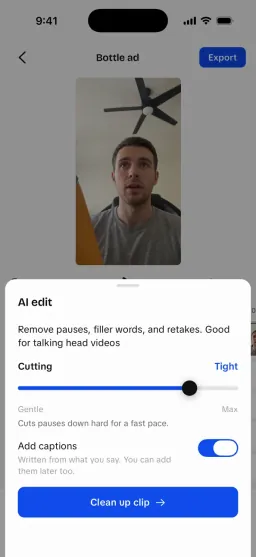
Not by keeping the first 10 seconds: the call to action is at the end, so it's the first thing to go. We cut each of our six synthetic takes with UGCLive's AI edit and looked at its first 10 seconds. None of the 6 kept its closing line (the call to action or the final pitch), which started 15.4 to 19.1 seconds into the cut, and the hooks didn't finish until 1.7 to 4.5 seconds in.
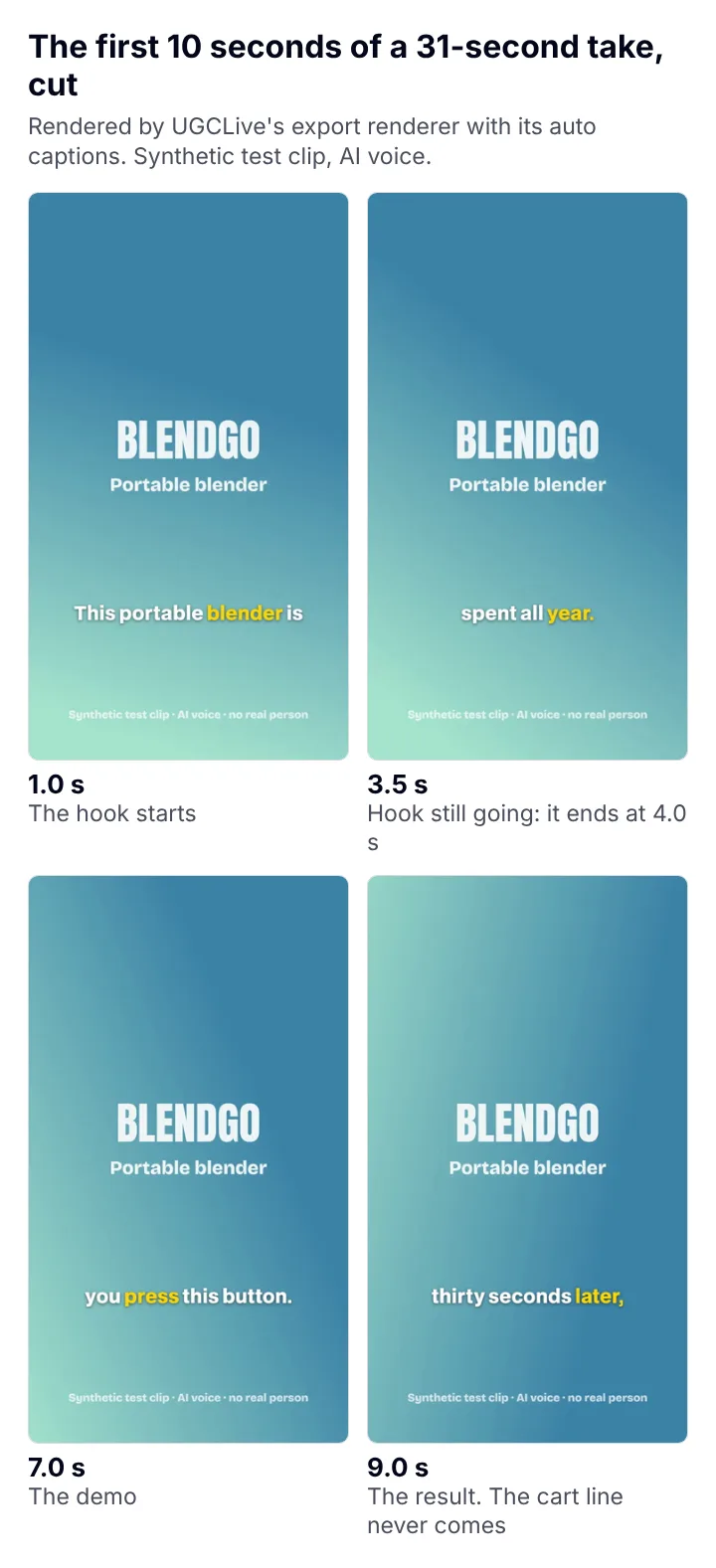
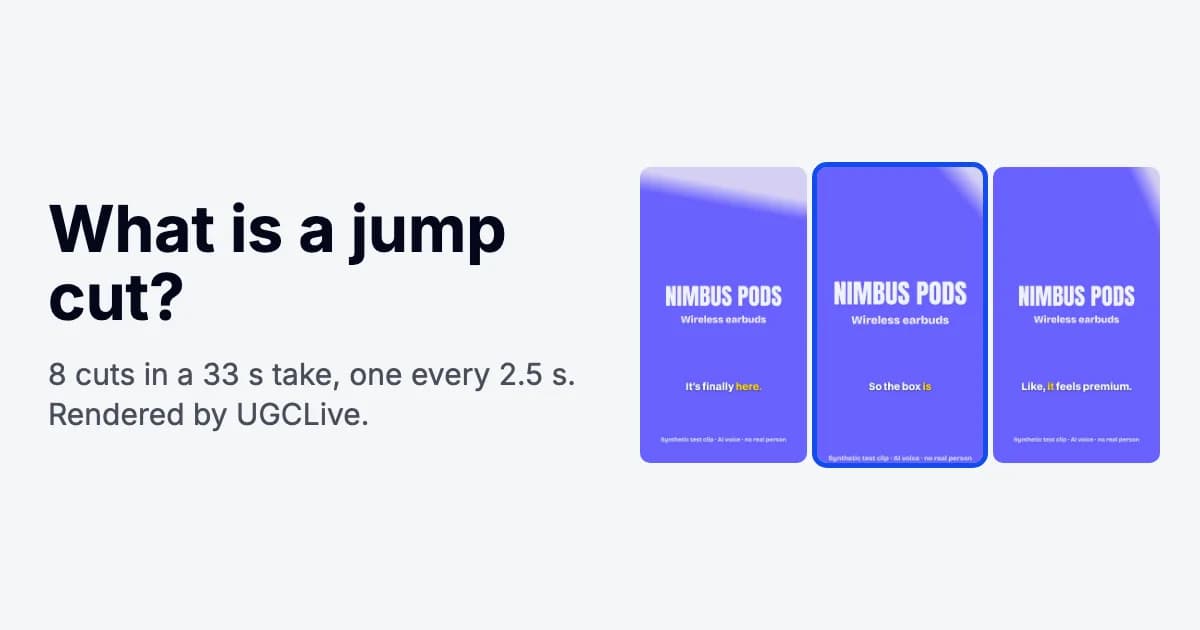
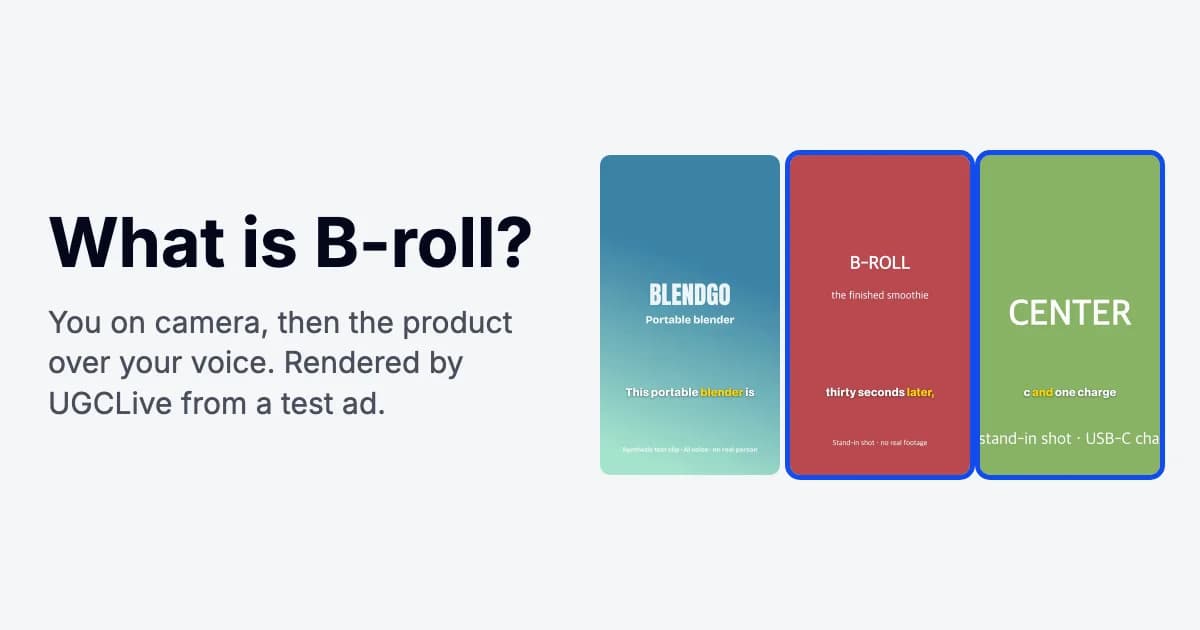
The rendered example above is the TikTok Shop take: 4 jump cuts and 30 words in 10 seconds, and the cart line never arrives. Re-editing works better: keeping only each take's hook and its last line left 2.2 to 5.8 seconds for one proof shot.
When is 10 seconds the right length?
When the proof fits in 5 seconds: one visible result, a product that explains itself in a single shot, or a reminder for people who've seen a longer video. If the product needs steps, a comparison or a claim that needs explaining, 12 words won't hold it; film a longer cut too. Because the body is so short, 10-second versions are also a cheap way to try three hooks on the same proof.
What didn't we test?
The takes are synthetic text-to-speech voices that speak faster and more evenly than most people, and their retakes were removed by hand labels in place of the AI step the app runs, so treat the counts as an example of the effect. The five scripts are ours, for products that don't exist, and we didn't test which would get more views or whether 10 seconds beats 15 or 30 for sales.