
























Short answer
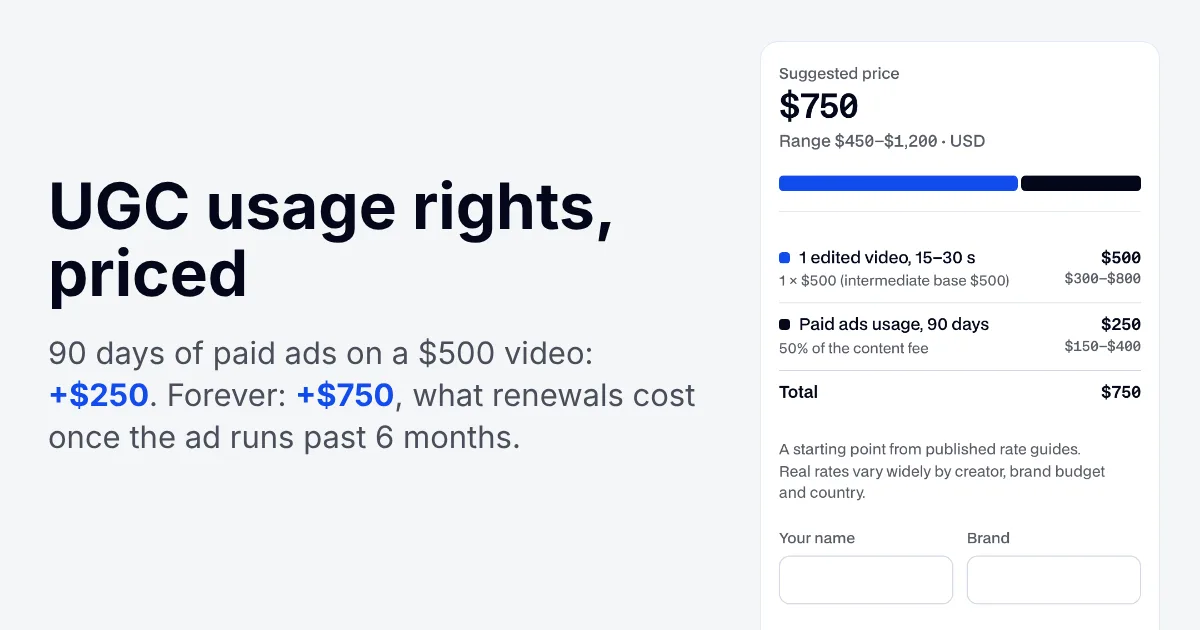
Usage rights are the license a brand gets to use your UGC video: where (its own posts, paid ads, ads from your account), for how long, and whether it's exclusive. You keep the copyright unless you sign it over. Price each right on top of the video: our rate calculator adds 50% for 90 days of paid ads ($250 on a $500 video) and 150% for perpetual use, which at those prices costs the brand no more than renewing once its ad runs past 6 months.
What do usage rights cover in a UGC deal?
They cover what the brand may do with the video after it pays: which channels, whether it runs as an ad, whose account the ad runs from, for how long, and whether you can work for its competitors meanwhile. Each is priced as its own line on a quote.
In the US you own the copyright in your video the moment it exists, and a transfer of copyright ownership is only valid in a writing you sign (17 U.S.C. § 204(a)). So a brand that pays for a video gets a license, the usage rights, unless the contract says you assign the copyright, which is what a "buyout" usually means. Watch for "work made for hire" wording too: for a commissioned video, a written agreement signed by both of you that calls it one makes the brand the author from the start (17 U.S.C. § 101), so price it as a buyout.
| Right | What the brand can do | UGCLive calculator | Published guides |
|---|---|---|---|
| Organic use | Post your video on its own accounts, unpaid | Included | Included, or SideShift's 10–20% |
| Paid usage | Run it as an ad from the brand's ad account | +30% for 30 days to +100% for 12 months | SideShift 25–50% (30–90 days), Billo 20–50% |
| Whitelisting or Spark Ads | Run it as an ad from your account, under your name | +30% per 30 days | SideShift 30–50% for whitelisting (30–60 days), Billo 50–100% |
| Perpetual use | Use it forever, no renewal | +150% | JoinBrands 50–100%, Billo and Influee 100–150%, SideShift 100–200% |
| Category exclusivity | Keep you from its competitors for a period | +20% per month | SideShift 20–50% per month; Billo 3–10× the licensing fee |
A Spark Ads code grants the account-level right for one TikTok video; our guide to Spark Ads codes covers making and revoking one.
How much should you add for usage rights, in dollars?
Between $53 and $1,800 per video in our run, depending on your rate and how long the brand wants the ad. We priced one edited 15 to 30 second video at each of our rate calculator's three experience levels, at its typical figure.
| Level and video fee | Paid, 30 days | Paid, 90 days | Paid, 12 months | Perpetual | Spark Ads, 30 days | Exclusivity, 3 months |
|---|---|---|---|---|---|---|
| Beginner: $175 | +$53 | +$88 | +$175 | +$263 | +$53 | +$105 |
| Intermediate: $500 | +$150 | +$250 | +$500 | +$750 | +$150 | +$300 |
| Experienced: $1,200 | +$360 | +$600 | +$1,200 | +$1,800 | +$360 | +$720 |
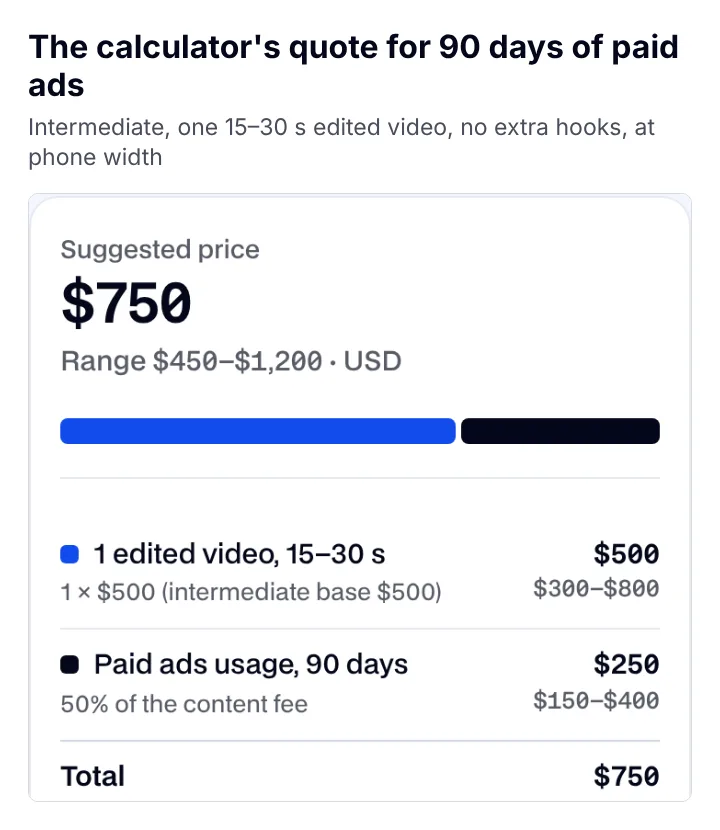
Spark Ads and paid usage stack: a brand that runs your video from its own account and from yours for the same 30 days pays both lines. Organic use stays at $0 here, as in most guides; list product pages and email in the quote if the brand wants them.
Is a perpetual buyout cheaper than renewing paid usage?
For the brand, yes, once the ad outlives a few windows. At our calculator's prices, perpetual use costs $750 on a $500 video; 90-day renewals at $250 each add up to the same $750 as soon as the ad runs past 6 months, and 30-day renewals at $150 past 4. We priced each renewal like the first window, as the calculator's quote does.
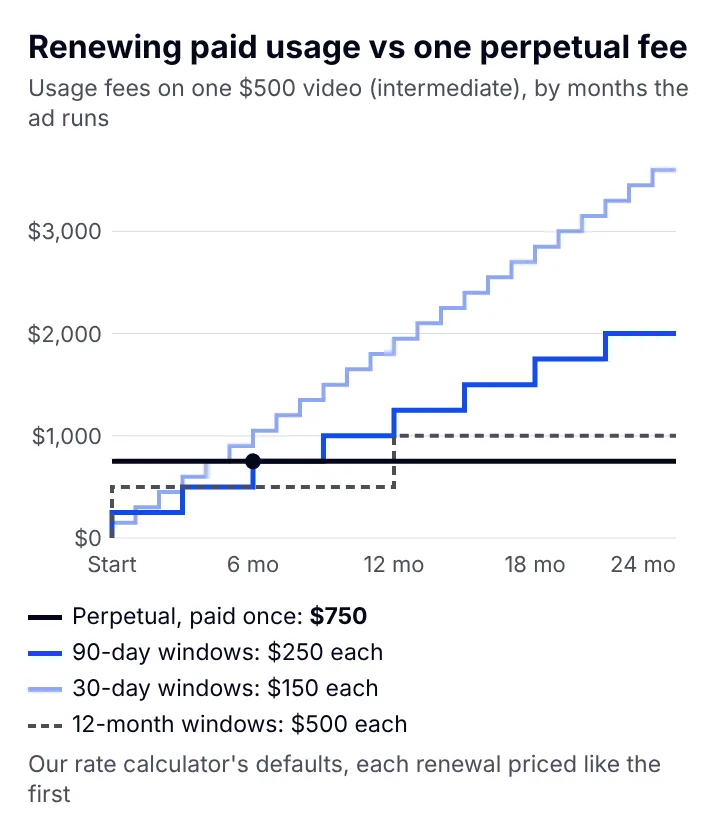
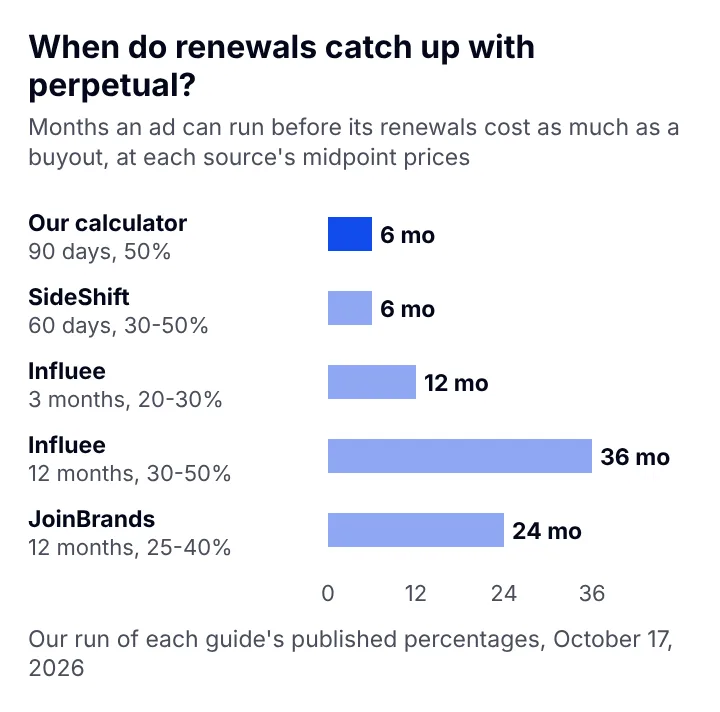
We ran the same sum on the midpoints each guide prints: renewals catch up with the buyout after 6 months on SideShift's figures and only after 36 on Influee's 12-month prices.
| Prices from | Paid window and add-on | Perpetual add-on | Windows that reach perpetual | Renewals reach perpetual after |
|---|---|---|---|---|
| UGCLive rate calculator | 90 days, 50% | 150% | 3 | 6 months |
| SideShift | 60 days, 30-50% (its $500 example) | 100-200% | 4 | 6 months |
| Influee | 3 months, 20-30% | 100-150% | 5 | 12 months |
| Influee | 12 months, 30-50% | 100-150% | 4 | 36 months |
| JoinBrands | 12 months, 25-40% | 50-100% | 3 | 24 months |
At +100%, the floor Billo, Influee and SideShift print, perpetual equals 2 of the calculator's 90-day windows, so once an ad runs past 3 months the buyout costs the brand no more than renewing. JoinBrands' 50 to 100% goes lower still.
Our pick: quote paid usage in 90-day windows, and price perpetual at no less than three of them (+150%, $750 on a $500 video), because at that price the buyout only matches what renewals would cost once the brand's ad has run longer than 6 months, so you're paid for those months either way. Past that point a buyout underpays you against renewing: on an ad that runs 2 years, 90-day renewals would come to $2,000 against the buyout's $750, so for a brand that says the video is evergreen, quote perpetual higher or offer 12-month renewals instead. If a brand only needs a launch, offer 30 days; if it wants 12 months, the calculator's +100% ($500) puts the same break-even at 12 months.
When does a usage window start, and what happens when it ends?
The contract names the date, and the choice can move the end of the window by weeks. Our two free tools pick different dates: the contract template counts from the day the brand approves the final video, the rate calculator's quote from the day the brand first runs it.
| Window starts | Window ends | Days the ad can actually run |
|---|---|---|
| On approval, November 2 | January 31 | 48 |
| On first run, December 14 | March 14 | 90 |
Counting from approval protects you: the end date is fixed and known to you, though a slow brand loses 42 of its 90 days in our example. Counting from first run gives the brand its full 90 days, but only the brand knows that date. A middle ground to write in: "starts on the date the Brand first runs the Content as an ad, and no later than 30 days after approval".
In our template, the brand stops paid ads and publishes nothing new when the window ends, and you choose whether its organic posts come down within 14 days or stay up unboosted. Leave the end date out and you've granted more than you meant: Billo's guide says rights without an end date are, in practice, perpetual.
What should the usage clause in your contract say?
It should list the channels, the length and start date, whether paid use is in, what happens at the end, and who owns the file. We filled in our contract template for three deals and kept the lines that changed:
- Organic only, 3 months
"Paid use is not included: the Brand may not run the Content as paid ads, or boost it, without a new written agreement and fee."
- 12 months of paid ads plus a 30-day Spark Ads code
"Paid use is included: the Brand may run the Content as ads from its own accounts during that time." A separate section gives the brand advertiser access to your account for 30 days, for its own fee, and only for the approved video.
- Perpetual, with a buyout
"This right lasts with no end date (perpetual). Territory: worldwide." and "Once the Brand has paid every fee in this agreement, the Creator transfers (assigns) the copyright in the final Content to the Brand. Until then, the Creator owns it."
Perpetual use and a buyout aren't the same thing. With a perpetual license you still own the video, and the template keeps the line "The Creator owns the copyright in the Content. The Brand gets the usage rights above (a license), not ownership. The Creator won't license this Content to anyone else while those rights last." With a buyout the brand owns it outright. Every version lets the brand trim the video and add its logo, captions, prices and calls to action, which covers cutting it into new lengths, and keeps one line we'd never drop: the brand can't use your face, voice or likeness to train AI or make AI versions of you without a separate fee. The whitelisting section names both TikTok Spark Ads and Meta partnership ads, and ends access when the period ends.
What did our run leave out?
Every dollar figure is our rate calculator's defaults, and every outside percentage a guide's midpoint, not what brands paid. The guides don't publish the deals behind their percentages (Billo credits another company's benchmarks), and they disagree by up to four times on perpetual use.
We assumed each renewal costs what the first window did, and didn't price territory, licensed music or other people on screen, which Billo's guide covers. Our contract template offers terms of 3, 6, 12 or 24 months and perpetual, so a 30-day paid window has to be written in by hand. SideShift and Influee say perpetual rights come by default with work booked through their platforms, so there's no usage line to price there. Our template calls itself a starting template, not legal advice, and laws differ by country and state.